

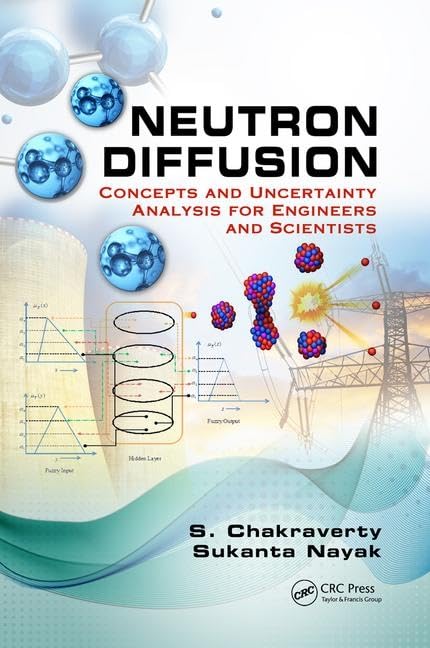
Reactor Core Design Mathematics: Computational Geometry in Core Configuration: Hands on with Python (Nuclear Engineering Essentials)
Product details
| Management number | 219247716 | Release Date | 2026/05/03 | List Price | US$24.00 | Model Number | 219247716 | ||
|---|---|---|---|---|---|---|---|---|---|
| Category | |||||||||
Book Description:Dive into the complexities of reactor core design through the lens of computational geometry and discover how these techniques can lead to more efficient, safer, and innovative core configurations. From foundational theories to advanced simulation methods, this book offers a detailed exploration of the mathematical and computational tools essential in the field. Enrich your understanding by implementing each concept with step-by-step Python code tailored to enhance your learning experience.Key Features:- Comprehensive coverage of computational geometry essential for modern reactor core design.- Detailed Python examples accompanying every chapter to reinforce practical understanding.- An up-to-date discussion on the application of quantum computing in core simulations.- High-performance computing techniques for handling complex core simulations.- Guide to advanced algorithms, data structures, and mathematical models used in core configuration.What You Will Learn:- Gain insights into the fundamentals of computational geometry applied to reactor cores.- Explore various coordinate systems and their applications in core layouts.- Master vector algebra and its role in computational geometry tasks.- Understand geometric transformations through matrix operations and Python code.- Calculate line intersections critical for reactor core layouts.- Implement 3D plane geometry principles in core applications.- Employ polygonal meshes to enhance reactor core configuration.- Optimize reactor core geometry using convex hull algorithms.- Apply Voronoi diagrams for spatial partitioning in core design.- Leverage Delaunay triangulation for efficient mesh generation.- Detect geometric intersections within the reactor core environment.- Manage spatial data using bounding volume hierarchies.- Utilize octrees and quadtrees for spatial partitioning and meshing efficiency.- Implement sweep line algorithms for effective collision detection.- Perform geometry validation using cyclic redundancy checks (CRC).- Optimize core shapes employing Bezier curves and NURBS techniques.- Apply graph theory to model connectivity in reactor configurations.- Develop optimal inspection and maintenance routes using pathfinding algorithms.- Apply genetic algorithms and simulated annealing for core design optimization.- Deploy parallel algorithms for real-time core simulation handling.- Use finite element analysis to assess structural integrity.- Model thermal distribution within cores using spectral methods.- Conduct radiation transport calculations for improved core safety.- Integrate multiphysics simulations for comprehensive core analyses.- Explore Monte Carlo methods for neutron transport simulation.- Refine surface mesh and utilize mesh refinement for precise computational models.- Examine lattice symmetry and its implications in core design.- Implement adaptive mesh generation to respond to dynamic conditions. Read more
| ISBN13 | 979-8343719048 |
|---|---|
| Language | English |
| Publisher | Independently published |
| Dimensions | 6 x 1.13 x 9 inches |
| Item Weight | 1.55 pounds |
| Print length | 417 pages |
| Part of series | Nuclear Engineering Essentials |
| Publication date | October 19, 2024 |
Bestseller ranking
Nuclear





Customers who viewed this product also viewed
Knee-High Socks

![RANDY SUN Waterproof Skiing Socks, [SGS Certified] Unisex Knee High Breathable Hiking Trekking Sock 1 Pair](https://m.media-amazon.com/images/I/91IsnKHRVqL._AC_SL1500_.jpg)



Correction of product information
If you notice any omissions or errors in the product information on this page, please use the correction request form below.
Correction Request Form